A deadlock in OS is a situation in which more than one process is blocked because it is holding a resource and also requires some resource that is acquired by some other process. The four necessary conditions for a deadlock situation to occur are mutual exclusion, hold and wait, no preemption and circular set. We can prevent a deadlock by preventing any one of these conditions. There are different ways to detect and recover a system from deadlock.
All the processes in a system require some resources such as central processing unit(CPU), file storage, input/output devices, etc to execute it. Once the execution is finished, the process releases the resource it was holding. However, when many processes run on a system they also compete for these resources they require for execution. This may arise a deadlock situation.
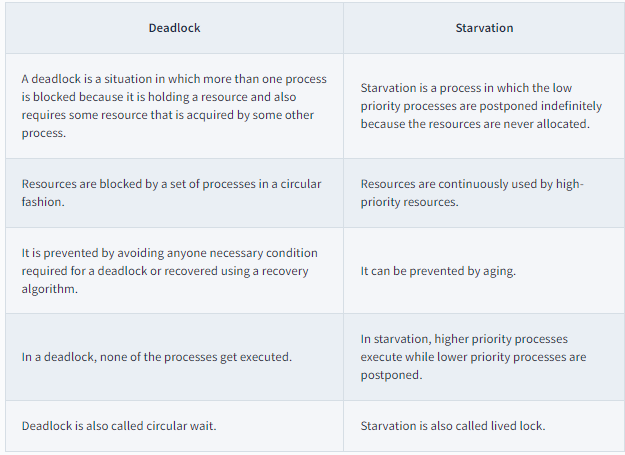
A deadlock is a situation in which more than one process is blocked because it is holding a resource and also requires some resource that is acquired by some other process. Therefore, none of the processes gets executed.
These are the four necessary conditions for deadlock :
Only one process can use a resource at any given time i.e. the resources are non-sharable.
From the resource point of view, the mutual exclusion means that simultaneously more than one process cannot use the same resource. However, this is fair enough, but due to this, a deadlock occurs. If there is a possibility that we can use the same resource for more than one process at a time, there will be no process that will be waiting for the resource.
Although, if we can stop the resources performing in a mutually exclusive manner, then in this way, we can prevent the system from the deadlock.
Spooling: - Spooling stands for Simultaneous Peripheral Operations On-line. We use spooling for devices such as Printer, Mouse, Keyboard. Let’s understand the working spooling process of a printer:
- In a printer, memory is associated with it.
- With the help of this memory, we can store the jobs of all the processes.
- Then all the jobs are collected, and after gathering all the jobs, the printer prints each of the jobs in FCFS (First Come First Serve) manner. If we use this procedure, then no process will need to wait for the printer.
- Finally, when the outputs are produced, the printer collects them.
So, with the help of Spooling, we can stop mutual exclusion, but we may suffer two kinds of problems:
- We cannot use spooling for every resource.
- In spooling, a rare condition between the processes may occur in which the processes want some space in the spool. At the same time, we cannot force to use the same resources for more than one process. Because this approach fails here and if we are doing this, then there may be a possibility that some serious problems may arise related to the process. So, we can say that practically the violation of mutual exclusion is not possible.
A process is holding at least one resource at a time and is waiting to acquire other resources held by some other process.
Hold and Wait is a condition where a process holds a resource and still waits for other resources to finish its job. In this situation, there is a possibility of deadlock because more than one process holding one resource each and cyclically wait for other resources for their execution. So, we need to find some procedure through which either process does not hold any resource or does not wait for any resource. This means we should assign all the resources which the process needs before starting its execution. Then, the execution of the process starts without waiting for any resource.
Practically we can implement this only if in starting the process, determine all the resources which the process needs. Although it sounds very practical, in the computer system, we cannot do this; the reason is at the start, no process can define the necessary resources.
Process means a set of instructions that are executed by the CPU. At multiple times each instruction requests for different resources. But the demand for the resources cannot be fixed by the operating system.
The approach has the following issues:
- It is not possible, practically.
- There may be a chance of starvation because, in some cases, the process can hold a resource for a long time.
The resource can be released by a process voluntarily i.e. after execution of the process.
The reason for the deadlock occurrence is that once the process starts its execution, then it cannot be halt. But we can prevent deadlock if we take away those resources from the process that may cause deadlock. But this is not a suitable approach because if we bring out a resource that is being used by the process, then this will be inconsistent with the work we have done until now.
For example: Suppose we have a printer that a process is using, and we take the printer away from that process and assign the printer to some other process. So in this way, the data which is printed by the printer become inconsistent as well as ineffective. Also, the process will not start printing further from where it left the process so, due to this performance can be inefficient.
A set of processes are waiting for each other in a circular fashion. For example, lets say there are a set of processes { P0, P1, P2, P3 } such that P0 depends P1, P1 depends P2, P2 depends on P3 and P3 depends on P0. This creates a circular relation between all these processes and they have to wait forever to be executed.
Circular wait is the condition in which one or more process waits for the required resources in a circular order. By assigning the priority number to every resource, we can solve the problem of a circular wait. The process cannot request a resource that has lesser priority value. It assures that no process should demand the resource that is being used by the other process. Hence, no cycle will be formed.
So, by examining all these conditions, we found that there is only one approach that we can implement practically for preventing deadlock, and that approach is a violation of circular wait.
Example :
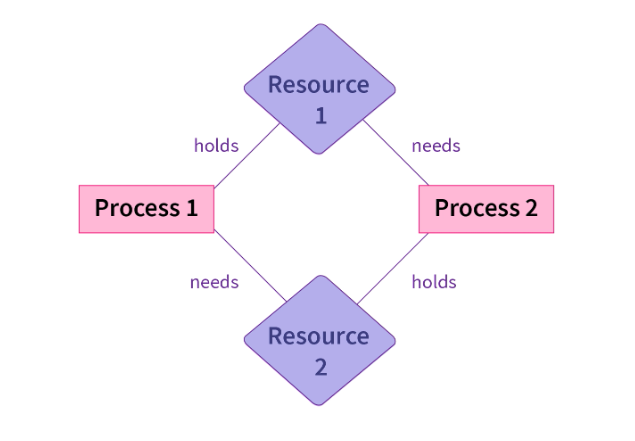
In the above figure, there are two processes and two resources. Process 1 holds "Resource 1" and needs "Resource 2" while Process 2 holds "Resource 2" and requires "Resource 1". This creates a situation of deadlock because none of the two processes can be executed. Since the resources are non-shareable they can only be used by one process at a time(Mutual Exclusion). Each process is holding a resource and waiting for the other process the release the resource it requires. None of the two processes releases their resources before their execution and this creates a circular wait. Therefore, all four conditions are satisfied.
The first two methods are used to ensure the system never enters a deadlock.
-
Deadlock Prevention : This is done by restraining the ways a request can be made. Since deadlock occurs when all the above four conditions are met, we try to prevent any one of them, thus preventing a deadlock.
-
Deadlock Avoidance : When a process requests a resource, the deadlock avoidance algorithm examines the resource-allocation state. If allocating that resource sends the system into an unsafe state, the request is got granted.
Therefore, it requires additional information such as how many resources of each type is required by a process. If the system enters into an unsafe state, it has to take a step back to avoid deadlock.
- Deadlock Detection and Recovery : We let the system fall into a deadlock and if it happens, we detect it using a detection algorithm and try to recover.
Some ways of recovery are as follows.
- Aborting all the deadlocked processes.
- Abort one process at a time until the system recovers from the deadlock.
- Resource Preemption: Resources are taken one by one from a process and assigned to higher priority processes until the deadlock is resolved.
- Deadlock Ignorance :
In the method, the system assumes that deadlock never occurs. Since the problem of deadlock situation is not frequent, some systems simply ignore it. Operating systems such as UNIX and Windows follow this approach. However, if a deadlock occurs we can reboot our system and the deadlock is resolved automatically.
Note: The above approach is an example of Ostrich Algorithm. It is a strategy of ignoring potential problems on the basis that they are extremely rare.
- No preemption is needed for deadlocks.
- It is a good method if the state of the resource can be saved and restored easily.
- It is good for activities that perform a single burst of activity.
- It does not need run-time computations because the problem is solved in system design.
- The processes must know the maximum resource of each type required to execute it.
- Preemptions are frequently encountered.
- It delays the process initiation.
- There are inherent pre-emption losses.
- It does not support incremental request of resources.
- A deadlock in OS is a situation in which more than one process is blocked because it is holding a resource and also requires some resource that is acquired by some other process.
- The four necessary conditions for a deadlock situation are mutual exclusion, no preemption, hold and wait and circular set.
- There are four methods of handling deadlocks - deadlock avoidance, deadlock prevention, deadline detection and recovery and deadlock ignorance.
- We can prevent a deadlock by preventing any one of the four necessary conditions for a deadlock.
- There are different ways of detecting and recovering a deadlock in a system.
- A starvation is a situation in which lower priority processes are postponed indefinitely while higher priority processes are executed.
- The advantages of deadlock handling methods are that no preemption is needed and it is good for activities that require a single burst of activity.
- The disadvantages of deadlock handling methods are it delays process initiation and preemptions are frequently encountered in it.